|
|
 |
| ||||
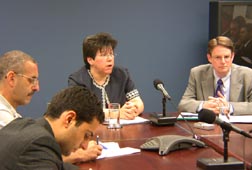
Protecting Global Aviation: Keeping Nicaraguan man-Portable Air Defense Systems Out of the Hands of Terrorists Rose Linkins, Acting Assistant Secretary of State for Political-Military Affairs; Daniel W. Fisk, Deputy Assistant Secretary of State for Central and Cuban Affairs Foreign Press Center Briefing Washington, DC June 24, 2005
MR. BRAZIER: Welcome, ladies and gentlemen, to the Washington
Foreign Press Center. We are very pleased today to have with us Acting
Assistant Secretary of State for Political-Military Affairs Ambassador
Rose Likins, and we also have with us Deputy Assistant Secretary of State
for Central American and Cuban Affairs Dan Fisk. They will be speaking to
us on the topic of: "Protecting Global Aviation: Keeping Nicaraguan
Man-Portable Air Defense Systems Out of the Hands of Terrorists." I believe you are going to start, Ambassador Likins. Afterwards, we
will ask for questions, and if you'll just introduce yourself and your
paper when you ask your question. Thank you very much. AMBASSADOR LIKINS: Thank you all very much for coming this
afternoon. Before I start, I just wanted to be clear I'm going to use the
term MANPADS repeatedly and so MANPADS, when we use that term, is
Man-Portable Air Defense Systems. So I just wanted to do that
clarification first. It's no secret to any of us that MANPADS pose a significant threat to
commercial and military aviation. In 2002, two missiles launched by
al-Qaida operatives narrowly missed a civilian airliner with 275 people
onboard in Mombassa, Kenya. Since the 1970s, more than 40 commercial
aircraft have been attacked with MANPADS, causing at least 24 crashes and
more than 600 deaths worldwide. Recognizing this threat, the United States and the International Civil
Aviation Organization have called on the international community and
regional organizations to control and safeguard MANPADS to prevent them
from falling into the hands of terrorists. The United States has worked
closely with 13 countries that have voluntarily cooperated with the United
States to destroy their excess and obsolete MANPADS. With United States
assistance, over 13,000 MANPADS have been destroyed and an additional
6,000 have been committed for destruction in the immediate future. The
United States also assists with stockpile management and security of
MANPADS and small arms and light weapons stockpiles. We count Nicaragua as one of those cooperating countries, with 1,000
MANPADS from their inventory already destroyed. At the same time, we
applaud Nicaragua's initiative for a collection and destruction program
meant to eliminate the threat posed by small arms and light weapons. This
is a significant step in the right direction to eliminate the threat of
illicit small arms and light weapons. However, the United States Government considers the large number of
remaining MANPADS currently held by Nicaragua to be a serious threat, not
just to the Western Hemisphere but to the entire world, because it also
offers a possible target of opportunity by terrorist groups for illicit
trafficking and worldwide use. The potential for MANPADS, even those located in the Western
Hemisphere, to fall into the hands of global terrorist networks is a
security risk for all nations, including those of Europe. An attack on a
commercial airliner in the Western Hemisphere from a leaked MANPADS would
have devastating effects on the European aviation industry as well as on
its tourism industry. The Nicaraguan Government recovered an SA-7, which is a type of a
MANPADS, during a sting operation in January of this year, further
highlighting that these weapons in the hands of the wrong people pose a
serious threat. Nicaraguan President Enrique Bolanos assured President Bush and former
Secretary of State Powell in 2003 that Nicaragua would destroy all of its
MANPADS in order to reduce the chance that they might fall into the hands
of criminals and terrorists. Since then, the Nicaraguan Government has
destroyed some of its MANPADS with U.S. Government assistance but many
remain in its national stocks. The recent national assembly law which requires that body's approval
for any further MANPADS destruction is a serious obstacle to Nicaraguan
President Bolanos' attempt to do the right thing, to destroy the MANPADS
for the good of its national as well as regional security. As a result of
the move by the national assembly, the United States has temporarily
suspended military assistance to underscore the importance the United
States places on the destruction of these MANPADS and on the promise made
by President Bolanos. We are committed to reinstating this assistance once
the destruction of all MANPADS has taken place. It's our goal to ensure that further cooperation on MANPADS remains on
track. This means that the Sandinista Party and the Sandinista president
of the legislative assembly need to accept responsibility for this grave
threat to international civil aviation and do the right thing; namely,
allow the assembly to pass legislation authorizing the Nicaraguan
Government to destroy the remaining MANPADS in the military's inventory.
We have discussed this several times with President Bolanos and his
cabinet as well as with members of the Nicaraguan assembly, and our
message remains the same: All MANPADS need to be destroyed. Nicaragua, as you know, is a member of the Organization of American
States. The OAS adopted on June 7th at its 35th General Assembly a
resolution to deny MANPADS to terrorists. Similar guidelines have been
adopted by other regions, such as the Organization for Security and
Cooperation in Europe and the Wassenaar Arrangement. Part of the
commitments that Nicaragua signed onto at the OAS General Assembly include
adopting and maintaining strict national controls and security measures,
destroying surplus MANPADS, securing effectively those needed for national
security and banning all transfers of MANPADS to non-state actors. Members of the European Union and other European countries have engaged
on the issue of MANPADS security and transfer controls through the G-8,
the Wassenaar Arrangement and the OSCE. Non-European associations, like
the Asia Pacific Economic Cooperation and the Organization of American
States, of which Nicaragua is a member, have developed these strict
controls. Our European allies have recognized the urgency of denying terrorists
and non-state actors access to MANPADS and we have urged them to engage
their Nicaraguan counterparts to pressure the Sandinista-led national
assembly to pass the law that would allow complete destruction of all
inventoried MANPADS. Thank you very much for your attention. MR. BRAZIER: Thank you very much. Did you have a comment? MR. FISK: No, thank you. MR. BRAZIER: Very good. Let's go right to the questions. Jyri. QUESTION: Why Nicaragua? Is Nicaragua somehow promised land of
MANPADS? There are lots of those in Eastern Europe, around the world.
Well, why -- AMBASSADOR LIKINS: Nicaragua has 1,000. Nobody else in that
region, certainly in Central America, has 1,000 MANPADS. Nicaragua also
has had a track record. You may recall the case of trafficking of small
arms and light weapons from Nicaragua to Colombia to rebels. The case that
I mentioned in my initial statement on the case in January where, in the
middle of a drug sting, in fact, an SA-7 was uncovered. And so because it is such a large number for this region and because
there is, in fact, a history that would lead us to have concerns about the
safety of these very dangerous weapons. QUESTION: Can I clarify this figure? It says that they have
1,000 and they have destroyed 1,000. AMBASSADOR LIKINS: One thousand. That's right. They destroyed
1,000 and there are about 1,000 left. QUESTION: What's their sort of domestic need for those? Are they
-- AMBASSADOR LIKINS: I certainly can't believe they have one or I
wouldn't be pushing them to destroy them. These are weapons that are of no
particular use in any military context for any threat that they would
face. What they are is a threat to civil aviation. QUESTION: Are they obsolete? Are they old stocks that they
themselves don't use? AMBASSADOR LIKINS: No. I mean, it's -- they've had the weapons
for some time but they are in no sense obsolete. One of the tremendous
risk factors associated with MANPADS is that they are so easy to use. They
are very portable and the parts are interchangeable, so that if you have a
grip stock on a weapon that goes bad, you swap that one out, put another
one on, and this missile is still going to work. And that is why we and
our European partners and so many organizations are so concerned about
these weapons. They are portable. They are easy to use. It's point and
shoot. And it is something that causes us a great deal of concern. QUESTION: Jorge Banales from the Spanish News Agency EFE. What is the origin of these weapons and how do you determine when there
is an excess? What is an excess? How do you determine what a country needs
and what is an excess? AMBASSADOR LIKINS: We understand that the origin of these
weapons was that they were transferred from the Soviet Union to Nicaragua
during the period of conflict in the '80s. Excess, of course, is a judgment that everybody has to make. I think
that every military would make that judgment. I don't -- there is no magic
number that the U.S. Government proposes is the right number. But it
involves a calculation of looking at the potential threat and the value of
this potential weapons system to help meet your threat. The fact of the
matter is, in the case of Nicaragua, that assessment has been made not
just by President Bolanos but by the Nicaraguan military, and in March of
this year General Debayle, who is the chief of the armed forces in
Nicaragua, went to the Nicaraguan legislature and said to them that the
military supported this destruction. The Nicaraguan military does not
believe that they need these weapons. They have supported the effort to
destroy them. In many countries around the world, keeping track of, keeping safe,
maintaining inventory of such a dangerous weapon is a burden and there are
countries with whom we have worked who have asked us for our assistance
because they don't want the responsibility of such dangerous weapons. MR. FISK: Let me add a point, if I may, on your question. I
understand the basis of your question on access. I don't think that's the
dynamic here. You've got a Central American dynamic. The threat to Central
America, not just Nicaragua, does not call for the surface-to-air
missiles, these MANPADS. They are a legacy of the Cold War and they are a
qualitatively different weapon than you see in the rest of the Central
American isthmus. And if you to Nicaragua south in Costa Rica, there is a
gendarmerie. There is a police force, not even a military. And so what we
have to keep going back to is you've got this large number in a region
which has decided to move forward, as you all may have covered the issue
of CAFTA, the Central America Free Trade Agreement, they're talking about
integration, there's cooperation at the political level. So when you ask
the Nicaraguans what's your threat, we're hard pressed to see that they
have a threat. And then you add the nature of these weapons, which is unique, and we
know that the one group of people that want these weapons are terrorists
and we've seen that in a number of instances. And then you add to that
again one final element, which is that Nicaragua has a history of weapons
leaking from that country or leaving that country and appearing in other
places, as Ambassador Likins mentioned earlier, there were 3,000 AK-47s
diverted in the fall of 1999. And in fact, just to go back even further on
MANPADS, in 1993 there was an explosion of a private arms cache which was
associated with the former Sandinista Interior Minister, in which they
found 20 surface-to-air missiles, exactly the kind of missiles we're
talking about now we want destroyed. This is something, as Ambassador Likins mentioned, again, that
President Bolanos has focused on, that the commander of the armed forces,
both the current one -- the Nicaraguan commander of the armed forces, both
the current one and his immediate predecessor, have focused on the need
for Nicaragua to get these weapons out of their investigation. QUESTION: Ms. Likins, you mentioned that the Sandinistas have a
responsibility in this situation and you mentioned that Nicaragua has a
record of leaking weapons that could reach to terrorists. Do you actually
imply that the Sandinistas could leak the weapons to these terrorists?
AMBASSADOR LIKINS: No, that's not what I'm saying here. I'm
saying that the Sandinistas are responsible because the body that has not
taken action is the legislature. The president has made the commitment,
the military has supported his judgment, and the president has proposed
legislation that is in the hands of the legislature. The Sandinistas
control that body. They have not scheduled a vote. To the contrary, last
week they announced that they were opposed to destruction of these
weapons. And so that is why I put the responsibility on the Sandinistas. They
are the president of the legislature. It is in their hands to vote on this
legislation. It is in their hands to vote for this legislation. Dan, do you want to add anything? MR. FISK: No, that sums it up very well. QUESTION: Jyri Raivio, Sanomat, Finland. Have they indicated any
reason? Why are they opposed to destruction? MR. FISK: The Sandinista Party has issued a declaration that
they oppose the destruction of MANPADS outside of a regional agreement on
balance of forces. So what they want to do is bring MANPADS into a Central
American discussion about how Central America should reconfigure its
security apparatus and security structures. The point there that I think we have to go back to is Nicaragua has a
number of weapons systems that should be the basis of regional discussion.
They have attack helicopters. Other countries have A-37s or F-5s. So all
this needs to be a point of discussion and we've encouraged the Central
Americans to discuss those. But we've got to go back to the fundamental
point here on MANPADS. This is a qualitatively different weapons system.
It does not serve any immediate threat to Nicaragua and you go back,
again, who -- you know, the fact that you had one of these appear in
January of this year in an operation with someone trying to sell one. So
again, I mean, this dynamic is why we've gone back to the Nicaraguans a
number of times and said this is something that you need to address. And go back to a point that Ambassador Likins made and that I've made,
is that the Nicaraguan national security structure agrees with this. This
should not be part of the Nicaraguan political dynamic. It need not be
part of the Central American regional balance of forces dynamic. QUESTION: You mentioned that the U.S. suspended military
assistance for Nicaragua. Is that a new decision and what kind of money
are we talking about? AMBASSADOR LIKINS: I think it was reported first several months
ago in the New York Times and so that's not a new decision and the
Nicaraguans are aware of that and we've talked to them about it. But I
can't -- you know, as part of the State Department that's responsible for
military assistance, I can't pretend like it's business as usual. This is
an important issue. And what we are trying to do is call people's
attention. The other thing I would point out in connection with this is that the
military component of our assistance to Nicaragua is relatively small.
We're talking about less than $2 million. Whereas, our much larger
economic assistance programs have continued. And that's something -- Dan,
correct me -- $41 million. MR. FISK: Roughly. AMBASSADOR LIKINS: Yeah. So the economic assistance programs
that are important to quality of life for the vast majority of Nicaraguans
who live in poverty is not interrupted by this, but we are trying to make
a point directly related to the military relationship that we are not
going to have a normal military relationship with Nicaragua without this
issue being resolved. QUESTION: Have you come across or has the U.S. come across any
MANPADS elsewhere in the world that actually have come from Nicaragua?
AMBASSADOR LIKINS: Not that we know about. I mean, I would tell
you that the black market and the gray market in arms trafficking, as you
know, is very opaque and so none of us pretend to have particular insight
into this. But I would point you back to the Busby Report that the 1999
incident that Dan and I have both mentioned where the Nicaraguan weapons
were trafficked to Colombia. When the Busby Commission that was appointed
by the OAS to investigate that incident went around and did its
investigation, they discovered that al-Qaida was shopping in Europe for
MANPADS and al-Qaida told the arms merchants it was dealing with to go to
Nicaragua to look for MANPADS because they knew there were a lot of them
there. If that was true in 1999 and we, the U.S. Government, have helped
to take 13,000 MANPADS out of business, out of circulation, we have no
reason to believe that al-Qaida is not still looking for those weapons. If
they were looking for them in '99, I guarantee you they're still looking
for them in 2005. This is the terrorist weapon of choice. QUESTION: Are you familiar with the technical means of
protecting civil airlines against this kind of weapon? In America -- AMBASSADOR LIKINS: Somewhat. QUESTION: Is there going to be some strict requirement by the
government? AMBASSADOR LIKINS: I think I'll let the Department of Homeland
Security talk to you about that. That's really their area, not mine. But
the Department of Homeland Security is seized of the issue and they, I am
sure, would be happy to talk to you about that. QUESTION: But at the moment there basically is nothing to
protect a civil airliner against a missile like this? AMBASSADOR LIKINS: Right. I mean, it is primarily military
technology and I think a lot of airlines -- again, and I'm speaking, you
know, here on very general knowledge that a lot of airlines have concluded
that it's very expensive to try and adapt that military technology for
civilian use. And so you may have seen the same press report I saw last
week that Raytheon has announced that they have developed a system that
would protect airports instead of airplanes. And while it still might be
somewhat costly, it would be more -- it would be more to the point because
we believe that planes are most vulnerable when they're in their approach
to an airport. When you're taking off you're going pretty much straight up
and you go up pretty fast, but when you're making your approach in is when
the experts believe that you are most vulnerable. And so Raytheon's
attempt to market a system that would protect airports, I think, goes in
those directions. But again, I am not the expert so I encourage you to talk to someone in
security about that. QUESTION: Even though it's a small problem, what was the type of
military assistance that the United States was giving to Nicaragua? AMBASSADOR LIKINS: A lot of it is training and a lot of it is
rebuilding a relationship. As you probably know, for many years we did not
have a robust mil-to-mil relationship with Nicaragua. We've been working
very hard with the Nicaraguans to rebuild that relationship. And so it's
been kind of, you know, escalating steps towards a more robust
relationship. We've had very good results from those contacts. We do
military exercises in Nicaragua with Nicaragua. Nicaragua participates in
regional military exercises. We do training. And there's some small amount
of equipment that, using FMF funds, Nicaragua was seeking to purchase.
Yes, sir. QUESTION: Can you mention any other country that would be so of
grave concern in this respect, a country that -- where the problem is
similar? AMBASSADOR LIKINS: Well, I mean, we've had tremendous success
with quite a number of countries. I mentioned the 13 countries that have
destroyed 13,000. And, I mean, I look at my notes about which ones I can
talk about publicly because some of them have asked us not to talk about
it publicly and so I want to be very careful that I respect that request
for confidence. I don't appear to have that in my notes today. Mark, is there any one
or two that you would point to that we can talk about publicly? MR. ADAMS: Not specifically in the region, but in Third World
countries in Africa, in Guinea, in Senegal we've done weapons destruction
programs that have been very successful. They started out as just a
regular conventional small arms destruction programs and as we got into it
and we found MANPADS there, there were obviously highly (inaudible)
weapons system to get (inaudible). AMBASSADOR LIKINS: I believe I'm correct that the NATO PFP
program is public? MR. ADAMS: That's correct. (Inaudible.) AMBASSADOR LIKINS: We have a -- there is a NATO, through the PFP
program, has a program and a formal agreement with Ukraine. Ukraine holds
a large number of MANPADS and they have committed to destroying 1,000 of
those in the very near future. And over the lifetime of what is projected
to be a 12-year program to destroy both small arms and light weapons and
MANPADS, we anticipate that there will be additional MANPADS from Ukraine
that will be destroyed in that program. And that's part of their NATO PFP
program. QUESTION: You mentioned that these weapons that Nicaragua has
come from the Soviet Union (inaudible) at least 15 years old, and I assume
they are sort of the same class of weapons, the same type of weapons. And
any of these for civilian aircraft that have been attacked with MANPADS
since 1970, have these weapons been used, these kind of weapons have been
used, these same kind of weapons? AMBASSADOR LIKINS: The SA-7, generally speaking, around the
world is one of what they call the first generation MANPADS. It's one of
the earliest manufactured and made widely available. And they account for
the vast bulk of MANPADS that are in circulation in the world. QUESTION: How do they work? Is it just -- AMBASSADOR LIKINS: Why don't I ask an expert? MR. ADAMS: The first generation, the SA-7s, are heat-seekers but
the newer generation MANPADS basically can shoot either direction so it
doesn't have to wait for the plane to pass, it can hit the plane head on.
QUESTION: Do you remember or are you aware of this attack in
Kenya where al-Qaida shoot an Israeli airline? AMBASSADOR LIKINS: Mmm-hmm. Mombassa. QUESTION: Where did that MANPADS come from? AMBASSADOR LIKINS: I don't know that we know where the MANPADS
came from, but it was certainly a wakeup call for all of us that we needed
to pay more attention to this issue. MR. BRAZIER: Any other questions? If not, I wish to thank our
speakers, Acting Assistant Secretary Likins and Deputy Assistant Secretary
Fisk for sharing so freely with us, and I thank our journalists for
attending as well. Have a good afternoon.
| |||||
 | |
| |
|
This site is managed by the Bureau of Public Affairs, U.S. Department of State. External links to other Internet sites should not be construed as an endorsement of the views or privacy policies contained therein. |