 |
|

|
| ||||
Fact Sheet Bureau of Political-Military Affairs Washington, DC September 20, 2005 The MANPADS Menace: Combating the Threat to Global Aviation from Man-Portable Air Defense Systems
This fact sheet provides a brief description of
MANPADS, their origins, examples of MANPADS attacks on civilian aircraft,
and highlights some of the United States’ efforts to work with other
countries to counter the threat. What
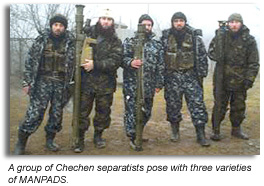
Are MANPADS? Man-portable air defense systems (MANPADS),
commonly described as shoulder-fired anti-aircraft missiles, are short
range surface-to-air missiles that can be carried and fired by a single
individual or carried by several individuals and fired by more than one
person acting as a crew. Most MANPADS consist of: 1) a missile packaged in
a tube; 2) a launching mechanism (commonly known as a "gripstock"); and 3)
a battery. The tubes have an aiming device, which protect the missile
until it has been fired, and are normally disposable. The missiles
themselves usually contain the homing device(s) that direct them towards
their aerial target. MANPADS (tube with missile within), typically
range from about 4 feet to 6 1/2 feet (1.2 to 2 meters) in length and are
about 3 inches (72 millimeters) in diameter. Their weight, with launcher,
ranges from about 28 pounds to just over 55 pounds (13 to 25 kilograms).
They are easy to transport and conceal. Some of the most commonly
proliferated MANPADS are about the size and weight of a full golf bag and
can easily fit into the trunk of an automobile. There are three main types of MANPADS
classified primarily by their guidance systems or "seekers": 1) Infrared
(IR) that hone in on an aircraft’s heat source, usually the engine’s
exhaust plume; 2) Command Line-of-Sight (CLOS) whereby the MANPADS
operator visually acquires the target aircraft using a magnified optical
sight and then uses radio controls to guide the missile into the aircraft;
and 3) Laser Beam Riders in which the missile flies along the laser beam
and strikes the aircraft where the operator has aimed the laser.
MANPADS are intended to be used by legitimate
national military forces to protect their troops and facilities.
Typically, they are deployed by troops defending themselves or an
installation from aerial attack. With their relatively short range,
MANPADS are generally the last missile-based air defense and are often
deployed in tandem with gun-type systems that seek to defeat attacking
aircraft by destroying them with a barrage of projectiles. MANPADS can strike aircraft flying at altitudes
up to approximately 15,000 feet (4572 meters) at a range of up to 3 miles
(4.82 kilometers). MANPADS should not be confused with
rocket-propelled grenades (RPGs). RPGs are also portable and
shoulder-fired. However, RPGs are designed primarily to be used against
ground targets and are usually ineffective against aircraft that are in
flight. Some RPG attacks on low-flying aircraft have been mistaken for
MANPADS attacks. Who Makes
MANPADS? Approximately 20 countries have produced or
have licenses to produce MANPADS or their components. These include
Bulgaria, China, Egypt, France, Germany, Greece, Iran, Japan, the
Netherlands, North Korea, Pakistan, Poland, Romania, Russia, Serbia and
Montenegro, Sweden, Turkey, the United States, and the United Kingdom.
It is estimated that over 1 million MANPADS
missiles have been manufactured worldwide to date. The United States
believes that most of these systems are in national inventories or that
they have been destroyed, but in many cases, these systems have not been
accounted for. Who
Possesses Them? MANPADS are found in the stockpiles of most
countries around the world, including those of manufacturing nations. But
several thousand may be outside of the control of governments. The number
of MANPADS remaining in the global inventory is difficult to estimate with
more precision because the destruction of MANPADS systems is not always
publicized and a system’s shelf life depends heavily on how it is stored
and maintained. The United States has strict controls over its
MANPADS and exercises diligence when selling them to legitimate
governments in order to ensure that they are properly secured and not sold
or transferred to others without legal consent. Given the unique threat posed by MANPADS to
aviation due to their potential lethality, relatively small size and
portability, U.S. policy supports a ban against the transfer of MANPADS to
non-state end users. When Have MANPADS
Been Used Against Civil Aviation? In 2003, the U.S. Department of State estimated
that since the 1970s, over 40 civilian aircraft have been hit by MANPADS,
causing about 25 crashes and over 600 deaths around the world. The
following is a partial list of reported incidents involving civilian
aircraft. This list includes one additional example of an incident
subsequent to the 2003 Department of State estimate, in which a civilian
aircraft was shot at by non-state actors using MANPADS. All of the
incidents listed below, except the Mombasa incident, took place in zones
of conflict.
Countering the proliferation of MANPADS is a
top national security priority of the United States. The White House
launched an initiative in late 2002 to prevent the acquisition of MANPADS
by terrorists and other non-state actors. At the direction of the White
House, the U.S. Department of State, supported by the U.S. Department of
Defense, leads the United States’ international efforts on this critical
issue. Within the Department, the Bureau of Political-Military Affairs and
the Bureau for International Security and Nonproliferation have
responsibility in this area. The Office of Weapons Removal and Abatement in
the Bureau of Political-Military Affairs manages the United States program
to eliminate obsolete MANPADS and to improve the security of MANPADS
stockpiles that may fall into the hands of non-state actors, either by
assisting countries to better secure their stockpiles or to destroy those
MANPADS stocks that are not needed for their defense. Many MANPADS
currently retained in national stockpiles are aged and obsolete and
relatively ineffective against modern military aircraft, but could still
pose a threat to slower-moving civilian aircraft. The Office of Export Control and Conventional
Arms Nonproliferation Policy in the Bureau for International Security and
Nonproliferation works to prevent transfers of MANPADS and the technology
to produce them to undesirable end-users through bilateral and
multilateral engagement, with an emphasis on responsible export controls.
The U.S. Department of Defense supports
international negotiations by providing expertise on the proper management
and control of MANPADS and enforcing stringent physical security and
accountability for MANPADS in U.S. possession. The Department of Defense
also established the Golden Sentry program to monitor the end use of
MANPADS sold through Foreign Military Sales to ensure that they are not
diverted for criminal use. Golden Sentry is supported by the Defense
Security and Cooperation Agency (DSCA), the Defense Threat Reduction
Agency (DTRA), and the U.S. Army. At the June 2003 G-8 Evian Summit, leaders
agreed to a U.S.-initiated MANPADS Action Plan that includes the following
measures: In 2005, the G-8 continues to focus on
implementation of these measures. In December 2003, the Wassenaar Arrangement,
the first multilateral institution
covering conventional weapons and sensitive dual-use goods and
technologies, adopted strengthened guidelines for control over MANPADS
transfers. These guidelines detail how countries will evaluate exports of
MANPADS; conditions they will set for recipients to receive the systems;
and how systems will be stored, transported, used, inventoried and
inspected. Similar guidelines were adopted by
the Organization for Security and Cooperation in Europe
(OSCE) in May 2004. The Asia Pacific
Economic Cooperation Forum adopted these guidelines in November 2004. In
June 2005, the Organization of American States 35th General Assembly also
adopted similar guidelines in Resolution AG/RES 2145 (XXXV-O/05).
The United States is continuing efforts in all
of these and other regional fora to emphasize the need for implementation.
The United States has submitted to the Wassenaar Arrangement and the OSCE
a detailed paper on how the United States controls MANPADS. It has
prompted other member nations to prepare their own such papers.
On February 18, 2005, the United States
announced
the start of a NATO Partnership for Peace Trust Fund Project to help
Ukraine destroy stockpiles of its excess munitions, small arms, light
weapons and MANPADS. Bilateral
Cooperation. United States bilateral efforts are focused on
regions and countries where there is a combination of excess MANPADS
stocks, poor control, and/or a demonstrable risk of proliferation to
terrorist groups or other undesirable end-users. The United States works
with countries whose MANPADS might be vulnerable to develop a
nonproliferation strategy to reduce stocks, secure remaining weapons, and
ensure that the host governments have in place appropriate policies and
procedures for controlling exports. The Office of Weapons Removal and
Abatement uses the Nonproliferation,
Anti-terrorism, Demining and Related
Project’s Small Arms and
Light Weapons Destruction Program funds to: Since 2003, the U.S. Department of State has
enabled the destruction of over 13,000 MANPADS in 13 countries in Africa,
Central America, Eastern Europe, and South East Asia. The total number of
MANPADS whose destruction has been facilitated by the United States is
over 17,000 to date. The United States has received commitments for the
destruction of approximately 6000 more and continues to pursue this
initiative worldwide. A few examples of some successes illustrate the
Department of State’s extensive efforts. The Office of Weapons Removal and
Abatement assisted Bosnia and Herzegovina in destroying its
government-held stockpile of almost 6000 MANPADS between 2003 and 2004,
helped to destroy 45 MANPADS in Liberia in 2003, helped Cambodia to
destroy its entire stock of 233 MANPADS in 2004 as well as better secure
other weapons kept for its national defense purposes, and has facilitated
Nicaragua’s destruction of nearly 1000 of its MANPADS to date. The Office of Weapons Removal and Abatement’s
MANPADS destruction programs are supported by the Defense Threat Reduction
Agency’s Conventional Weapons Branch, that provides technical management
and orientation seminars to guide host nation experts in U.S. best
practices, assess current host nation practices, and offer tailored advice
to countries on how to better secure their MANPADS and other weapons
retained for national defense purposes, at little or no cost to the host
nation. The Office of Weapons Removal and Abatement can, in some cases,
provide technical and financial assistance to implement the Defense Threat
Reduction Agency’s recommendations. Defense Threat Reduction Agency
assistance may also be provided to other countries at the request of
Regional Combatant Commanders or other elements of the U.S. Department of
Defense. The Office of Weapons Removal and
Abatement To learn more about the U.S. Department
of State’s Office of Weapons Removal and Abatement and its programs to
combat illicit trafficking in and better security for MANPADS and other
small arms and light weapons, and to provide humanitarian mine action
assistance worldwide, visit www.state.got/t/pm/wra The Office of Export Control and Conventional Arms Nonproliferation To learn more about the U.S. Department
of State’s efforts to prevent the proliferation of MANPADS and other
conventional weapons, visit www.state.gov/t/np. The Defense Threat Reduction Agency To learn more about the U.S. Department of Defense’s Defense Threat Reduction Agency efforts to improve the security of MANPADS stockpiles around the world, visit www.dtra.mil/toolbox/directorates/osi/programs/smarms/liaison.cfm. # # # | |||||
 | |
| |
This site is managed by the Bureau of Public Affairs, U.S. Department of State. External links to other Internet sites should not be construed as an endorsement of the views or privacy policies contained therein. Copyright Information | Disclaimers | |
 Man-portable air defense systems (MANPADS) in the hands of
criminals, terrorists, and other non-state actors pose a serious potential
threat to passenger air travel, the commercial aviation industry, and
military aircraft around the world. The United States and other concerned
countries have recognized and taken steps to counter the emerging MANPADS
threat to the international community. After the November 2002 attempted
shoot-down by terrorists of a civilian airliner in Mombasa, Kenya, the
United States redoubled its efforts to keep MANPADS from falling into the
wrong hands and is working closely with numerous countries and
international organizations to keep the skies safe for all. This
cooperation has led to the destruction of over 17,000 excess or illicitly
held MANPADS so far.
Man-portable air defense systems (MANPADS) in the hands of
criminals, terrorists, and other non-state actors pose a serious potential
threat to passenger air travel, the commercial aviation industry, and
military aircraft around the world. The United States and other concerned
countries have recognized and taken steps to counter the emerging MANPADS
threat to the international community. After the November 2002 attempted
shoot-down by terrorists of a civilian airliner in Mombasa, Kenya, the
United States redoubled its efforts to keep MANPADS from falling into the
wrong hands and is working closely with numerous countries and
international organizations to keep the skies safe for all. This
cooperation has led to the destruction of over 17,000 excess or illicitly
held MANPADS so far.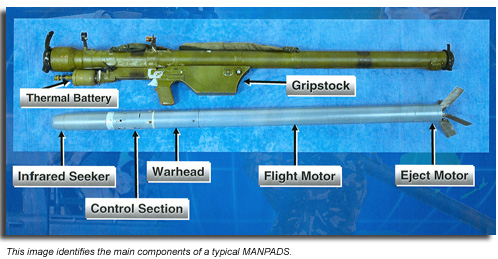
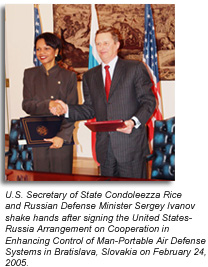 On February 24, 2005, U.S. Secretary of State Condoleezza Rice
and Russian Minister of Defense Sergey Ivanov
On February 24, 2005, U.S. Secretary of State Condoleezza Rice
and Russian Minister of Defense Sergey Ivanov